
| |
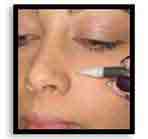
We use the
most effective toenail laser (Lasers Med Sci (2008)
23:349-353 comparing 7 lasers commonly used to treat
nails). This particular spectrum of light passes
through the nail without damaging it, yet kills the
fungus living under the nail. This new approach to
solving toenail fungus is more effective than
topical treatment and without the side effects of
taking pills. At the time of the procedure your
toenail will not become instantly clear, but as it
grows, the new nail will grow out normal as a result
of the death to the fungus. |
|
| |
 |
|
| |
Do I Need More
Than One Treatment? |
|
| |
Usually
one treatment is enough, but sometimes that depends
on the individual and the condition of your
toenails, which will be determined by your
podiatrist. We offer one free follow up treatment
for all our patients, just in case. |
|
| |
|
|
| |
Is the
Procedure Painful? How Long Does the Procedure Take? |
|
| |
This
procedure takes less than 15 minutes and is
completely painless, with no drugs or anesthesia
required. |
|
| |
|
|
| |
Will the Fungus
Grow Back? |
|
| |
During the
procedure, the fungus appears to be killed by the
laser light without harming the rest of your
toenail. Some individuals may have a predisposition
to the disease, however, or they have an aggressive
case that may require periodic treatment to kill any
new fungal infection that may arise. |
|
| |
|
|
| |
What Does FDA
Cleared Mean? |
|
| |
Our laser
has been cleared for dermatological use by the FDA.
This is considered a dermatological procedure. |
|
| |
|
|
| |
How Much Does
It Cost? |
|
| |
The cost
of the Procedure may vary by case. Please call our
office for pricing. |
|
| |
|
|
| |
Why Isn’t This
Covered By My Insurance? |
|
| |
This is
considered a cosmetic, not a medical procedure. It
causes clear nail growth through the death of the
fungus. Very few health insurance plans cover this
procedure. |
|
| |
|
|
| |
How Do I Pay
For This Procedure? |
|
| |
The
Doctors currently offer this procedure on a “fee for
service” basis only. You will have to pay for the
procedure at the time of your treatment. Cash,
checks, money orders, visa and mastercard accepted. |
|
| |
|
|
| |
We
recommend an appointment with Drs Teimouri and
Quattrone DPM prior to treatment to verify the
fungus and the benefit of the procedure to you. They
can answer all you medical questions. The can be
reached at 724-375-1577 and have 5 locations.
www.BVFootClinic.com
. To schedule the procedure call 724-987-3221 |
|
| |
|
|
| |
Advanced
Toenail Fungus Relief |
|
| |
First, let me answer the easiest
question. No, fungal toenails do not occur due to
poor personal hygiene. In fact, you can wash your
feet ten times a day and still be prone to getting
the dreaded thick and discolored nail. Now the
difficult question to answer is always, “How did I
get it?” Everybody has fungus on their toes and
fingers. They are living organisms that are part of
the “normal flora” of our skin. In other words, they
live together with different types of bacteria on
our skin. These living fungal organisms usually do
not cause any infection. But the fungus is an
opportunistic entity. It thrives in warm, moist
environments. And, when you injure your toenail by
stubbing it, dropping something on it, or even by
someone stepping on it, the nail itself lifts up
ever so slightly and sometimes comes off all the
way. In doing so, the fungus finds a way under the
nail and becomes protected by the nail itself. It
may then lie dormant for any amount of time. As it
slowly begins to infect the surrounding tissue,
gradual change in the nail may not be noticed until
several months after the injury. In fact, some
people can’t even remember a specific incident that
caused injury to a toe. Whatever the reason, fungal
toenails no longer have to be the embarrassing part
of the body that we hide in the sand at the beach or
paint all year round so nobody will see them.
Difficulty in treating fungal infections of the nail
is due to the infection being inside and under the
toenail - not just on top. The treatment must
penetrate the hard and thick nail in order to kill
the fungal infection. There are a number of
treatments available to you. The following are some
options depending upon the severity of the fungal
infection. |
|
| |
|
|
| |
|
What treatment is right for you? |
| |
|
1. Home Remedies
A few home remedies have been
suggested for treating the fungus:
Vicks Vapor Rub, vinegar, and even
soaking feet in diluted bleach.
However, there is no scientific
evidence that any one of these is an
effective way to cure the fungus. In
fact, there have been cases of
chemical burns due to the bleach
people have tried to use. |
| |
|
2. Topical
Treatments Anti-fungal creams
are quite effective for the fungus
in athlete’s feet but not the fungal
infection in the toenail. The over
the counter creams are not able to
penetrate the thick nail in order to
get to the fungus. Your podiatrist’s
office should be able to offer over
the counter topical treatments that
contain ingredients that are able to
carry the medication through the
nail in order to reach the fungus.
It may take anywhere from 4-6 months
to notice a difference. |
|
 |
|
|
| |
|
|
| |
3. Prescription Topical Again,
depending on the thickness of the nail, topical
applications are difficult to penetrate through to
the fungus. |
|
| |
|
|
| |
4. Anti-fungal Nail Polish One
should understand that wearing nail polish will
cover and suffocate the nail, preventing it from
“airing out”. However, fungus thrives in warm and
moist environments. For those patients who wish to
continue wearing nail polish, anti-fungal nail
polish is available. Usually it is applied daily for
7 days then wiped off and applied again for another
7 days until the fungus clears out. |
|
| |
|
|
| |
5. Oral Medications The most
commonly prescribed oral medication is Terbinafine (Lamisil).
This can be prescribed for the thicker nails that
haven’t responded to other treatments. Liver
function tests must be performed before starting the
medication because it gets metabolized through the
liver. The medication gets to the root of the nail
through the bloodstream and allows the nail to grow
out healthy and clear of fungus. One tablet is taken
daily for at least 3 months, and liver enzymes are
monitored throughout the treatment. |
|
| |
|
|
| |
6. Surgical Removal of the
Nail For recurring and severe staged fungal
toenails, surgical removal of that nail can be an
option. The thickened fungal nail can be removed and
a topical anti-fungal application can be used as the
new nail starts to grow. Because the area of
infection is exposed, the topical treatment is able
to kill the fungus more effectively. |
|
| |
|
|
| |
7. Laser Treatment Laser
treatment is the newest invention in the elimination
of toenail fungus. Quick and painless, it has proven
effective for the treatment of mild, moderate and
severe cases of toenail fungus. The treatment you
decide to use will depend upon the severity of the
toenail fungus. It is always in your best interest
to consult your podiatrist in order to obtain an
accurate diagnosis and the best treatment option
available to you personally. |
|
| |
|
|